Choosing & specifying
Wood-effect porcelain or a real wood floor?
Both give you the oak look. Only one of them goes on a terrace or in a shower room — and the one that doesn't comes with published limits on surface temperature, thermal resistance and room humidity that are worth reading before you choose.
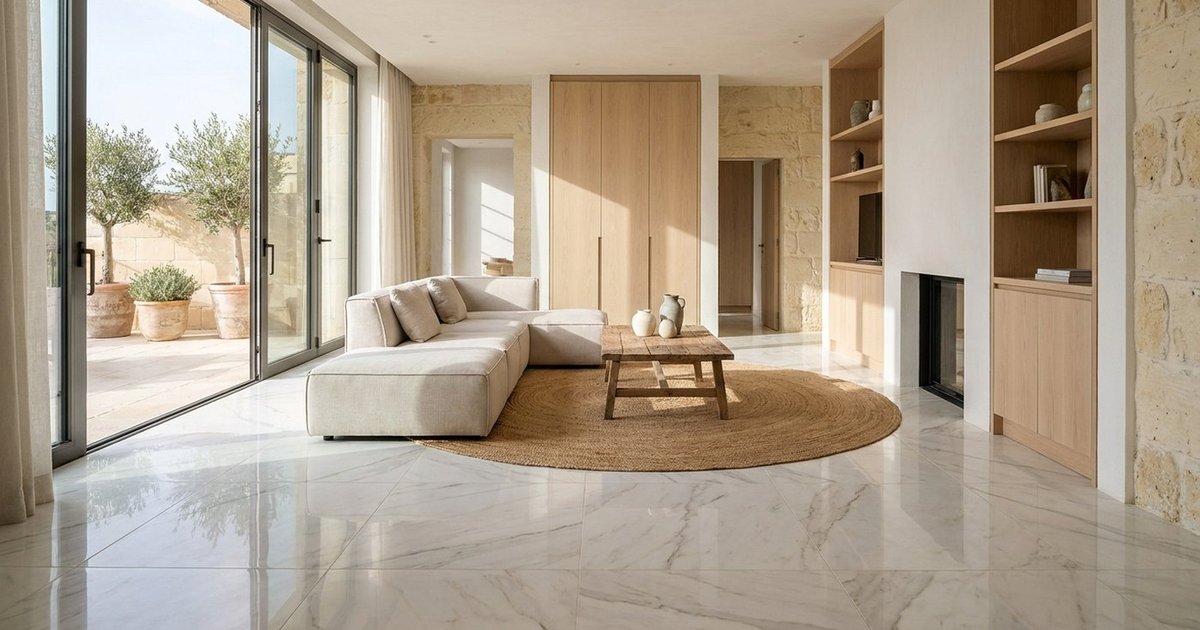
Two floors can look almost identical in a showroom and behave nothing alike once they are in a Maltese apartment. The question is rarely "which looks more like oak" — wood-effect porcelain has closed most of that gap — but "which one survives the room I am putting it in".
Where only porcelain works
Ceramica Rondine, an Italian tile maker, puts the case plainly in its own comparison: wood-effect porcelain is waterproof, which is why it suits high-traffic and humid rooms where parquet is weakest. That covers the two rooms most shell-form buyers are fitting out first — the bathroom and the kitchen.
Outdoors it is not a preference, it is the only option. Rondine states that only porcelain works outside, and describes its wood-look range as frost-proof and resistant to chemicals and weather. In a Maltese property with a terrace, a yard or a roof, that matters for a specific reason: a continuous visual run from the living room out through the aperture is one of the main reasons people choose a plank format in the first place. Parquet cannot do it. Porcelain can, and you can ask the showroom whether the same range is produced in both an indoor and an outdoor (thicker, textured) version.
Rondine also makes the maintenance argument: porcelain is easy to clean and needs none of the oils, waxes or polishing that natural wood needs, and it resists breakage, abrasion and impact. The Tilelook blog makes the same point from the tile side — porcelain is more resistant than natural wood, needs no periodic treatment, and is not degraded by moisture or stains.
Plank formats vary by range. Rondine's Aspen range, for example, is made in 15x100 and 20.5x100 cm. Those are that range's sizes, not market standards — every manufacturer sets its own, and the plank proportion changes the look considerably, so compare actual boxed sizes rather than catalogue photographs.
Underfloor heating: both can, with conditions
Underfloor heating is less common in Malta than in northern Europe, but EU buyers renovating a shell often specify it. Here the two materials diverge in how much paperwork they come with.
For porcelain, the Tilelook blog — a tile marketplace's publication, so a tile-industry source rather than independent testing — says wood-effect porcelain works well over underfloor heating, spreads heat evenly, and holds heat for a while after the system switches off, while conducting less well than metal. It gives common thicknesses of 8–12 mm, with some thinner versions of 3–6 mm.
For wood, the makers publish hard limits. Quick-Step says its parquet can be combined with underfloor heating if:
- the maximum contact temperature at the floor surface is 27 °C;
- the total thermal resistance is no more than 0.15 m² K/W;
- the system is a low-temperature one, with an insulating layer under the heating;
- the floor is glued, or floated only on Quick-Step's specified underlay.
Water-based and electric systems are both acceptable to Quick-Step if they meet those limits.
Weitzer Parkett's Information Sheet MB 020 (version 07-2025) is more detailed and worth reading in full if you are seriously considering wood. On temperature it reproduces two figures: DIN EN 1264 and ÖNORM B5236 set a maximum floor surface temperature of 29 °C for living areas, but the sheet itself states that the parquet surface must never exceed 27 °C, and notes that Swiss SIA 253 also sets 27 °C. Both numbers appear in the same document; the stricter one is the manufacturer's own instruction.
Weitzer gives the same 0.15 m² K/W ceiling on the thermal resistance of the whole build-up as Quick-Step, and adds that wood floors should be no thicker than 24 mm. Full-surface bonding gives the best heat transfer; floating floors are only suitable to a limited extent, because of higher resistance and the risk of creaking.
It also sets screed conditions that your contractor, not your showroom, has to meet: residual moisture of 1.8% CM for cement screed and 0.3% CM for anhydrite, with cement screed curing at least 21 days and anhydrite at least 7 days before heating starts. If a shell-form conversion is running to a tight programme, that is a real date in the schedule.
The room climate wood needs
This is the part buyers skip. Weitzer asks for relative humidity in the room to stay within a seasonal range of 30–65%, and is honest that even inside that range wood shows small gaps, cracks or cupping. The ideal for dimensional stability is 20 °C and 50% relative humidity, with at least 40% recommended during the heating season.
Those are the wood maker's requirements. None of the sources used here publishes humidity figures for Malta, so this article does not tell you whether your flat meets them — measure it. A cheap hygrometer in the room for a year, through the summer and through whatever heating you use, will tell you more than any generalisation about the Mediterranean.
Side by side
| Wood-effect porcelain | Multi-layer parquet | |
|---|---|---|
| Bathrooms, kitchens | Suited — waterproof (Rondine) | Weakest here (Rondine) |
| Terraces, outdoors | The only option; frost-proof, weather-resistant (Rondine) | Not an outdoor floor |
| Underfloor heating | Works well, even heat, holds heat after switch-off (Tilelook) | Yes, within limits: 27 °C surface, ≤0.15 m² K/W, ≤24 mm, glued preferred (Quick-Step, Weitzer) |
| Routine care | No oils, waxes or polishing; no periodic treatment (Rondine, Tilelook) | Needs oils, waxes or polishing (Rondine) |
| Room climate | Not specified by these sources | 30–65% RH; ideal 20 °C / 50% (Weitzer) |
| Thickness | Commonly 8–12 mm; some 3–6 mm (Tilelook) | Max 24 mm over heating (Weitzer) |
Buying it in Malta
Two practical notes that have nothing to do with the material and everything to do with the market.
Most Maltese showrooms publish no brand list, so you cannot tell from a website which of them stocks a particular wood-look series. The only reliable method is to identify the range and manufacturer first — write down the exact series name and size from the catalogue — then ask showrooms directly whether they carry it or can order it.
Sicily is a ferry ride away and frequently cheaper for the same Italian brands, and within the EU, VAT is paid once in the country of purchase, so a Sicilian invoice is not followed by a Maltese VAT bill. Set that against transport, your own time, and the fact that a defect claim on a floor bought across the water is a longer conversation. If the property is in Gozo, add a ferry crossing to every delivery, including the pallet you need three weeks later because someone miscounted the cuts.
Order a surplus either way. Wood-effect ranges are produced in batches with varied plank graphics, and matching a discontinued range two years later is not something any of these manufacturers promises.
Common questions
- Can I put real wood over underfloor heating?
- Yes, within limits set by the floor maker. Quick-Step says its parquet can be combined with underfloor heating provided the contact temperature at the floor surface does not exceed 27 °C, the total thermal resistance of the build-up is no more than 0.15 m² K/W, the system is a low-temperature one with an insulating layer beneath it, and the floor is glued down — or floated only on Quick-Step's specified underlay. Water-based and electric systems are both acceptable if they meet those limits. Weitzer Parkett also caps thermal resistance at 0.15 m² K/W and limits wood floors to 24 mm thickness.
- What is the maximum floor surface temperature for parquet?
- The two figures are different and both are published. Weitzer Parkett notes that DIN EN 1264 and ÖNORM B5236 set a maximum floor surface temperature of 29 °C for living areas, but the same information sheet states that the parquet surface must never exceed 27 °C, and that Swiss standard SIA 253 also sets 27 °C. Quick-Step gives a maximum contact temperature at the floor surface of 27 °C.
- Can wood-effect porcelain go outside on a terrace?
- Ceramica Rondine states that only porcelain works outdoors, and describes its wood-look range as frost-proof and resistant to chemicals and weather. Parquet is an indoor floor. If you want the same visual run from the living room out onto the terrace, porcelain is the only one of the two that can do it.
- Does wood-effect porcelain work over underfloor heating?
- The Tilelook blog, a tile marketplace publication, says it does: that it spreads heat evenly and holds heat for a while after the system switches off, while conducting less well than metal. That is a tile-industry source rather than independent testing. It gives common thicknesses of 8–12 mm, with some thinner versions of 3–6 mm.
- What humidity does a wood floor need?
- Weitzer Parkett asks for relative humidity to stay within a seasonal range of 30–65%, notes that even within that range wood shows small gaps, cracks or cupping, gives 20 °C and 50% relative humidity as the ideal for dimensional stability, and recommends at least 40% during the heating season. Those are the maker's requirements for the room, not a claim about any particular climate.
What we could not establish
- None of these sources gives humidity or temperature data for Malta, so this article does not state what Maltese indoor conditions are. Weitzer's figures are the wood maker's requirement; measuring your own rooms is the only way to know whether you meet them.
- No source gives prices, supply or fitting rates for either material, in Malta, Sicily or anywhere else.
- No source states slip resistance ratings for wood-effect porcelain — relevant for bathrooms, terraces and around pools, and worth asking the showroom for per range.
- Ceramica Rondine's page explicitly does not cover feel underfoot, acoustics or cost, and no other source here does either.
- No source sets a surface-temperature or thermal-resistance limit for porcelain over underfloor heating, so this article does not claim there is none.
- No source addresses Maltese screed construction, local installation practice, adhesives or how long screeds take to dry in Malta. Weitzer's screed figures are generic European ones.
Sources
- Wood-effect porcelain stoneware or parquet? — Ceramica Rondine (Italy) · read 2026-10-05
- Porcelain stoneware with wood effect for heated floors — Tilelook blog (Tecnobit S.r.l., Italy) · read 2026-10-05
- Can I use Quick-Step parquet in combination with underfloor heating? — Quick-Step (UK site) · read 2026-10-05
- Information Sheet MB 020 — Parquet on subfloor heating — Weitzer Parkett (Austria) · read 2026-10-05
Drafted with Claude — claude-opus-5, then read, corrected and approved by Neil Bennett before publication. We do not publish anything a person has not read.
Ready to price it?
One upload goes to every showroom that stocks what you are after, in Malta and Sicily.
Get quotes