Choosing & specifying
Large-format porcelain or ceramic in a Maltese flat?
Fewer joints, harder to lay, dearer per metre. A plain look at large-format porcelain against standard ceramic in a Maltese flat — the substrate, the staircase, the labour band, and the cases where 60×60 wins.
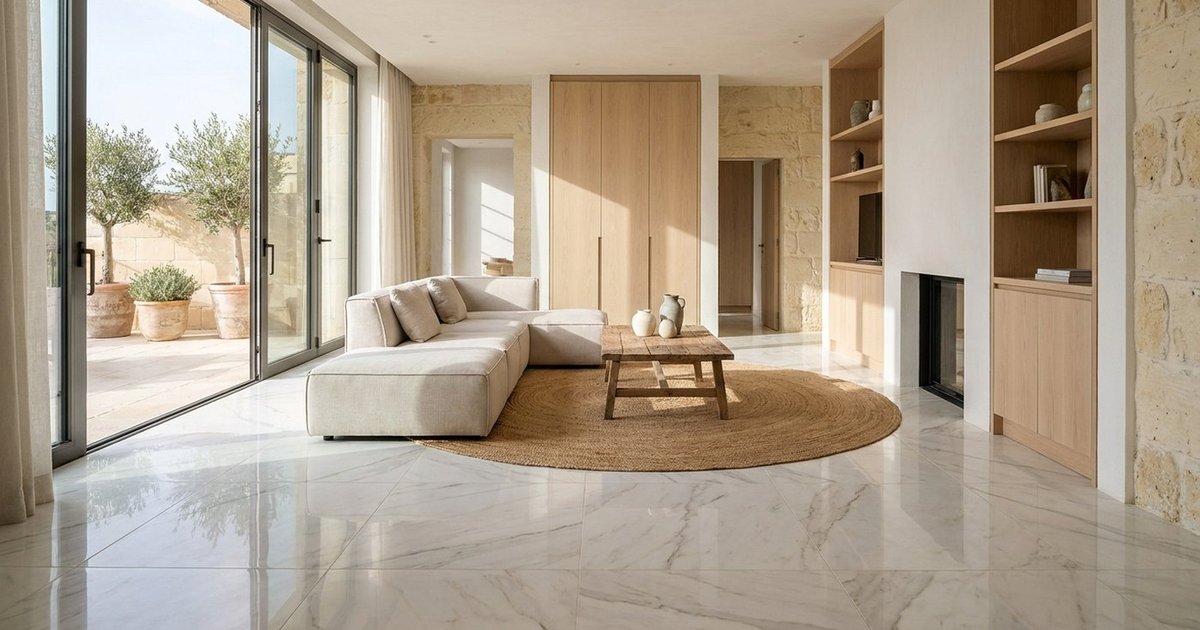
Most people arriving at this question have just bought a flat in shell form, have a floor area in their head, and have seen a showroom display where one enormous slab runs the width of a bathroom with no joint in it. The question is whether that is achievable in your flat, and what it costs you beyond the price per square metre.
What "large format" actually means
There is no legal definition. In practice the Maltese market treats 60×60 as the standard floor tile and anything above roughly 80×80 as large format, with 120×120, 120×60 and the very long plank formats at the top end. A few Malta retailers show porcelain online, but be clear about what a website can and cannot tell you here. No web page tells you which large-format ranges are physically in stock, in what dye lot, and in what quantity. Ask us and we will show you options that are.
The porcelain-versus-ceramic distinction is separate from the size question, though the two get conflated because large format is almost always porcelain. Porcelain is the denser body: it is the normal choice for floors, wet rooms and terraces. Ceramic is lighter and easier to cut, which still makes it a reasonable wall tile. Almost nothing is made in ceramic at 120×120, so once you have decided on large format you have effectively decided on porcelain.
What fewer joints buys you
Do the arithmetic before the aesthetics. A 20 m² room in 60×60 has roughly 55 tiles and somewhere around 65 running metres of grout joint. The same room in 120×120 has about 14 tiles and roughly half the grout. That is the whole argument, and it is a real one:
- Visual. Fewer interruptions make a small room read as larger. In a typical Maltese flat, where the living area and kitchen often share a single floor plane, a large format carried through both reads as one space rather than two.
- Cleaning. Grout is the part that discolours. Halving the joint length halves the problem.
- Continuity with the terrace. If you are running the same tile inside and out onto a terrace or balcony, larger formats make the threshold less busy.
What it does not buy you is durability. A 60×60 porcelain of the same technical class is the same material.
What the substrate has to be
This is where large format stops being a shopping decision and becomes a building decision.
A small tile can follow a gently uneven floor. Each tile tilts a fraction relative to its neighbour and the eye never catches it. A 120×120 slab cannot do this. It bridges the dip instead, and then one of three things happens: the tile rocks, it sits hollow underneath and cracks later under a point load, or its edge stands proud of the next slab — lipping — which you will see every time low evening light rakes across the floor.
In a shell-form Maltese flat the bare slab is not a tiling substrate. It normally needs a levelling screed, properly cured, before large-format work starts. Adhesive is not a levelling compound; a tiler building up 20 mm of adhesive under one corner of a slab is storing up a failure. If a tiler tells you the floor needs screeding before they will lay 120×120, that is not upselling, that is the constraint.
None of the sources in this article publishes a flatness tolerance for Maltese work — there is no published millimetres-over-two-metres figure to hold anyone to. Ask your tiler what standard they work to and get the answer in writing on the quote.
Walls are their own problem. Maltese internal walls are often hollow blockwork or plastered franka, and large slabs on a wall need both a flat plane and mechanical support during setting. Large format on a bathroom wall is a different job from large format on a bathroom floor, and should be priced separately.
The labour, and the staircase
Large format is a two-person job with a suction-frame lift, a levelling-clip system and a bridge saw or rail cutter with the capacity for the sheet. It is slower per square metre than 60×60 despite covering more ground per tile, because every cut is high-stakes and every slab has to be placed once, correctly.
Turnkey.mt's tiling and stone page publishes its rates for tiling work in bands. Read the figures there rather than from a summary in an article like this one: a directory page that lags behind a contractor's own published rate is worse than no figure at all. What matters for your planning is the shape of it — the work is banded, large-format and stone work does not sit in the same band as straightforward tiling, and you should expect the quote to reflect which band your job falls into.
Then there is getting the tiles into the flat. A 120×120 porcelain slab is heavy, awkward and inflexible, and a great many Maltese apartment buildings have a narrow dog-leg staircase and a lift that will not take it standing up. Measure your stairwell turn and your lift car before you commit to a format. If you are in Gozo, add a ferry to every delivery, and add the possibility that a cracked slab discovered on unpacking means another ferry crossing rather than a van trip.
Buying: showrooms, brands and Sicily
Most Maltese showrooms publish no brand list. You generally cannot determine online which Italian manufacturer's large-format range a given showroom carries, which is precisely why a single enquiry through us — matched to the showrooms carrying the brand you want — saves a fortnight of driving.
Sicily is a ferry ride away and is often cheaper for the same Italian brands. Within the EU, VAT is paid once in the country of purchase, so a Sicilian purchase is not taxed again on arrival. Weigh that against freight, and against dye lots: large format means few tiles, and few tiles means a single broken slab can be a meaningful fraction of a room. Buy the overage at the same time, from the same batch, and store it flat.
When 60×60 is the honest answer
Choose the smaller format when:
- The room is small and cut up. Under about 20 m², with door reveals, a shower tray and a duct, the waste and cutting eat the visual benefit.
- The substrate cannot be levelled economically. If screeding the whole floor costs more than the aesthetic gain is worth to you, the tile should follow the floor you have.
- Access is bad. A narrow staircase and no lift is a legitimate reason to stop at 60×60.
- You are on a budget that has to stretch. Higher tile cost, higher labour band and a screed is three increases in one decision.
| 60×60 ceramic or porcelain | 120×120 porcelain | |
|---|---|---|
| Substrate | Tolerant of minor unevenness | Needs a levelled, cured screed |
| Handling | One person, standard stairs | Two people, frame lift, check stairwell |
| Cutting waste | Low, forgiving | High stakes on every cut |
| Grout to clean | Roughly double | Roughly half |
| Labour band | Standard tiling | Large-format / stone band |
Large format is worth it when the room is big enough and flat enough to show it off. In every other case it is an expensive way to buy an idea from a showroom display.
Common questions
- Is large-format porcelain worth it in a small Maltese apartment?
- In a small flat the case for it is mostly visual — fewer grout lines make a room read as larger and calmer. But a small flat is also where the per-metre penalty bites hardest, because cutting and waste are proportionally higher in rooms full of short walls, door reveals and service ducts. If the space is under about 20 m² and broken up, 60×60 usually gives you most of the look for less money and less risk.
- Can my floor take 120×120 slabs?
- Only if it is flat enough. A large slab cannot follow a dip the way a small tile can; it bridges it, and the tile either rocks, sits hollow underneath or lippings against its neighbour. In a shell-form Maltese flat this normally means a levelling screed before tiling, not adhesive used as a filler. Get the tiler to check the existing slab with a straightedge before you buy the tiles, not after.
- Is porcelain always better than ceramic?
- Not always — it depends on where it goes. Porcelain is the denser body and is the normal choice for floors, wet areas and terraces. Ceramic is lighter and easier to cut, which still makes it a sensible wall tile. The sources here do not publish technical data such as water absorption or breaking strength for individual Maltese stock lines, so ask the showroom for the manufacturer's datasheet rather than relying on the category name.
- Should I buy the tiles in Sicily instead?
- It is worth a price comparison, because the same Italian brands are often cheaper at source and Sicily is a ferry ride away. Within the EU, VAT is paid once in the country of purchase, so you are not charged again on arrival in Malta. Set against that: freight, the risk of a dye-lot mismatch you cannot walk back into a showroom to fix, and the fact that a broken slab is a much bigger problem when the replacement is across the water.
What we could not establish
- No source used here publishes a substrate flatness tolerance — no millimetres-over-two-metres figure for large-format work in Malta is stated anywhere in this source set.
- The sources do not publish per-square-metre tile prices broken down by format, so there is no published Maltese figure for what 120×120 costs against 60×60 of the same range.
- No Malta showroom publishes a filterable brand and stock list, so you cannot tell from a website which brand's large-format range is actually in stock in Malta this month.
- No source here states whether the published tiling rates include adhesive, grout, levelling screed, waste allowance or a minimum job size.
- Nobody in this source set publishes a surcharge, or a rate, for carrying oversized slabs up stairs, for lift access limits, or for the Gozo ferry leg on a delivery.
- There is no published Maltese figure for breakage rates on large-format deliveries, or for how a broken slab is handled on a cross-border purchase.
Sources
- Tiling & Stone — Turnkey.mt — Turnkey.mt (a CheckYourTraders company) · read 2026-09-21
Drafted with Claude — claude-opus-5, then read, corrected and approved by Neil Bennett before publication. We do not publish anything a person has not read.
Ready to price it?
One upload goes to every showroom that stocks what you are after, in Malta and Sicily.
Get quotes