Quotes & installation
Tanking a Maltese bathroom before the tiles go on
Tiles and grout are a wearing surface, not a waterproof one. This is what tanking is, where it belongs in the order of trades on a Maltese bathroom, and what to ask a showroom's fitter before the first tile is laid.
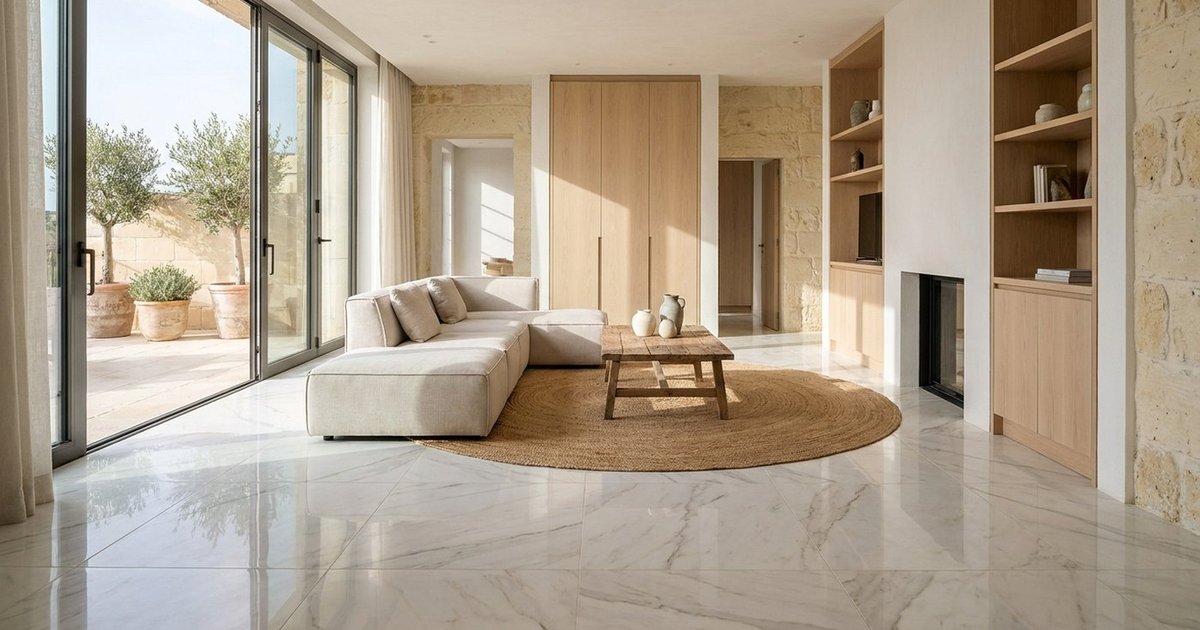
If you have just bought a shell or a mid-century flat in Malta and the bathroom is the first room you are tackling, the instinct is to start with the tiles. That is the visible decision, the one the showroom wants to talk about, and the one your friends will ask about. It is also the last decision that matters structurally. The layer that keeps water out of your neighbour's ceiling goes in before the tiles, and once the tiles are on you cannot inspect it, test it or fix it without taking them off again.
Tiles are a wearing surface, not a waterproof one
A porcelain tile is, in itself, close to impermeable. The assembly it sits in is not. Water moves through the grout joints, through the adhesive bed, down the junction where the wall meets the floor, and around the edge of a badly formed shower tray. Cementitious grout is porous by nature. Sealing it slows absorption; it does not turn a tiled surface into a tank.
This is why the waterproofing question in Malta is usually framed as a screed question rather than a tiling question. Kibitec, a Maltese contractor that publishes guidance on how to waterproof screed here, treats it as an operation on the substrate — the layer under the finish — rather than something you achieve with the finish itself. The logic is straightforward: the barrier has to be continuous and it has to be underneath, so it belongs to whoever is building up the floor, not to whoever is laying the last 10mm.
What "tanking" actually means
Tanking is shorthand for forming a continuous waterproof barrier across the surfaces that will get wet, so that any water passing the tiles is contained and taken back to the drain instead of soaking into the structure. In a bathroom that normally means the whole floor, the shower enclosure walls to full height, and the junctions — floor to wall, wall to wall, and around every penetration, which is to say the waste, the drain, and any pipe coming through a wall.
Two things follow from that definition, and both are worth holding on to when you read a quote:
- Area matters less than joints. Most failures are at junctions and penetrations, not in the middle of a wall. A quote that prices square metres without mentioning corners, upstands or the drain collar has priced the easy part.
- It has to be done before the tiles. There is no retrofit. Any "waterproofing" offered after tiling is a surface treatment, which is a different and much weaker thing.
Where it sits in the order of trades
Maltese tiling contractors describe their work as covering substrate preparation as well as laying — Turnkey.mt's tiling and stone page presents preparation and setting out as part of the service rather than something that happens before they arrive. That is useful, but it is also where responsibility gets blurred, because the waterproofing sits exactly on the seam between the screeding trade and the tiling trade.
A defensible order for a Maltese bathroom looks like this:
- Strip out. Remove old finishes and expose the substrate.
- First fix plumbing and electrics, including the drain position and any recessed niches.
- Substrate made good — levelling, and the falls set so water runs to the drain.
- Waterproofing applied, including junctions and penetrations, and given time to cure.
- Water test, before anything covers the membrane.
- Tiling — adhesive, tiles, then grout.
- Sanitaryware, silicone to movement joints, second fix.
The single most common way this goes wrong is not incompetence. It is that the screeder assumed the tiler would tank, the tiler assumed the screed was already waterproofed, and nobody wrote it down.
What it costs — and why there is no number here
We are not going to give you a rate. Neither of the sources behind this article publishes a per-square-metre price for tanking or bathroom waterproofing in Malta, and inventing one — or quietly borrowing a UK figure — would be worse than admitting the gap.
That absence is itself the finding. Waterproofing in Malta is typically folded into a screed price or a whole-bathroom price, which means you cannot see it and cannot compare it. What you can do is force it into the open:
- Ask for waterproofing as a separate line item, priced per square metre of treated area, with the treated area stated.
- Ask whether that area includes shower walls to full height, or floor only.
- Ask whether primer, junction tapes and drain collars are in the line or extra.
Once three quotes all present it that way, you can compare them. Until then you are comparing bathrooms, not barriers.
Questions to ask a showroom's fitter
Many Maltese showrooms will recommend or supply a fitter, and most publish nothing about how that fitter works — just as most publish no brand list. Ask directly:
- Who applies the waterproofing on this job, by trade?
- Does your price include it, or does it assume the shell is already tanked?
- Will you water-test before tiling, and can I be there?
- How long between the membrane going down and the first tile going on?
- What happens if there is a leak in two years — who do I call, and what does that cover?
If the answer to the last one is vague, note it. Neither source publishes what a workmanship guarantee covers in Malta, so the only version that exists is the one you get in writing.
Sicily and Gozo
Sicily is a ferry ride away and often cheaper for the same Italian brands, so plenty of buyers price tiles there. That does not move the tanking decision: membrane, primer, screed and adhesive are a separate purchase, normally sourced locally by whoever is doing the work. Within the EU, VAT is paid once in the country of purchase, so tiles bought and taxed in Sicily are not taxed again here — but keep the wet-trade materials with the trade that is warranting them.
If the property is in Gozo, every delivery is a ferry, and that includes the boring consumables. Sequence matters more there than in Sliema: a membrane that arrives three days late holds up the tiler, the sanitaryware and the plumber behind him.
Keep it on paper
Tanking is the one part of a bathroom you pay for and never see. The only protection against that is documentation: the line item, the treated area, the trade responsible, the test, and a photograph of the finished membrane before the first tile covers it. Take the photographs yourself.
Common questions
- Is grout waterproof?
- No. Cementitious grout is porous and the adhesive bed behind it is not a barrier either. Water that gets through the joints, or through a hairline crack in a tile, will keep going until it reaches something designed to stop it. That something is the waterproofing layer under the tiles, which in Malta is normally applied at the screed stage rather than as part of the tiling.
- What does tanking cost per square metre in Malta?
- Neither of the sources used for this article publishes a per-square-metre rate for tanking or waterproofing in Malta, so we do not quote one. Ask each showroom or fitter to price it as a separate line on the quote, stated per square metre of treated area, and compare those figures directly rather than accepting a single bundled bathroom price.
- Who does the tanking — the tiler or someone else?
- It depends on how the job is split. Waterproofing in Malta is described as part of getting the screed right, which can put it with the screeding or building contractor, while Maltese tiling contractors describe substrate preparation as part of their tiling and stone work. The risk is that both assume the other did it. Name the trade responsible in writing before anyone starts.
- Does buying tiles in Sicily change anything about the tanking?
- The membrane, primer, screed and adhesive are a separate purchase from the tiles and are usually sourced locally by whoever is doing the work, so buying tiles in Sicily does not move the waterproofing decision. Within the EU, VAT is paid once in the country of purchase, so Sicilian tiles bought and taxed there are not taxed again on arrival — but that is a tile question, not a tanking one.
- Can the membrane go over the old tiles in a refurbishment?
- Our sources do not establish this either way. In practice it turns on the condition and falls of what is underneath, which is why the substrate is inspected before anything is quoted. Treat any fitter who will commit to tiling over an unopened bathroom floor without looking at it as someone making an assumption on your behalf.
What we could not establish
- Neither source publishes a per-square-metre rate for tanking or bathroom waterproofing in Malta, so no price appears in this article.
- No named membrane products, brands or thicknesses are established by the sources — nothing here should be read as a specification.
- Curing and drying times before tiling, and whether Maltese summer heat shortens or complicates them, are not established.
- Whether any Maltese building requirement obliges a wet-room to be tanked, and who would enforce it, is not established by these sources.
- Whether showroom-supplied fitters carry insurance for water damage, and what any workmanship guarantee actually covers, is not published by either source.
- Nothing in the sources covers buying membranes or screed materials in Sicily, or the cost of ferrying them, and nothing covers Gozo delivery surcharges for wet-trade materials.
Sources
- How To Waterproof Screed In Malta — Kibitec — Kibitec Ltd (Malta) · read 2026-09-21
- Tiling & Stone — Turnkey.mt — Turnkey.mt (a CheckYourTraders company) · read 2026-09-21
Drafted with Claude — claude-opus-5, then read, corrected and approved by Neil Bennett before publication. We do not publish anything a person has not read.
Ready to price it?
One upload goes to every showroom that stocks what you are after, in Malta and Sicily.
Get quotes