Quotes & installation
After the tiler leaves: cleaning haze and sealing tiles
The first clean after the tiler leaves sets how a floor looks for years. What removes grout haze, what that acid would do to marble or limestone, and which finishes actually need a protective treatment.
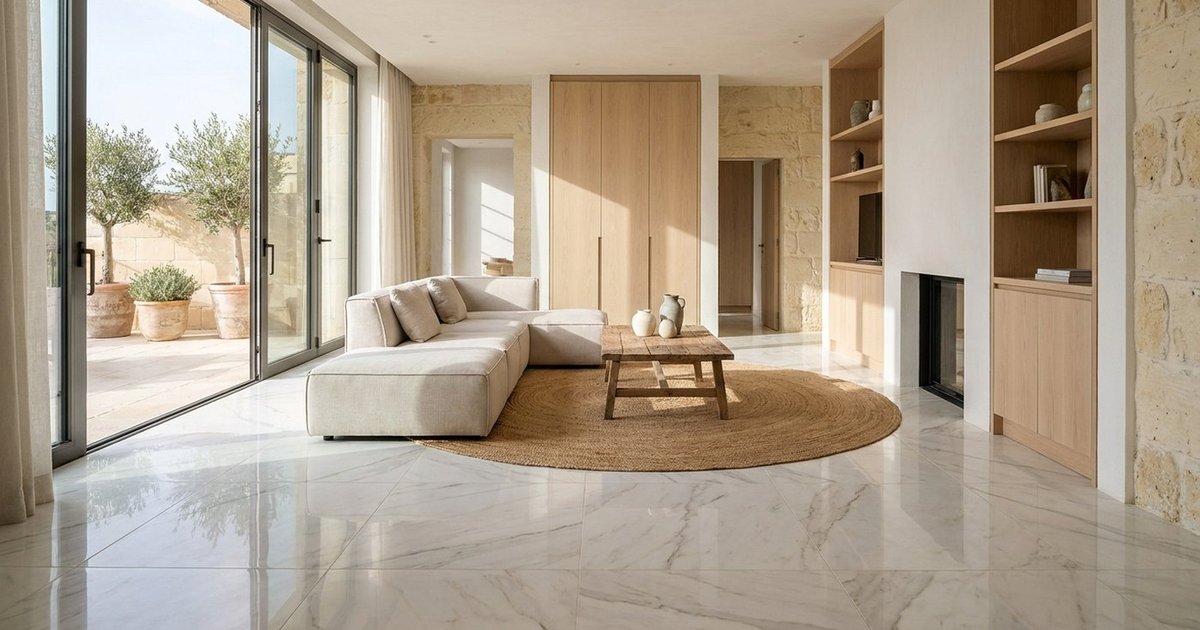
The handover at the end of a tiling job is the point where most new owners stop paying attention. The tiler sweeps up, the floor looks dusty but basically finished, and everyone assumes a mop will sort it out. It will not. The film left behind after grouting is cementitious, and Ceramiche Keope is blunt about the consequence: the post-installation clean has to be done promptly after laying, or the haze marks can become permanent. A floor that was cleaned badly in week one looks cloudy for its whole life, and no amount of routine mopping later changes that.
If you have bought a property in shell form and the tiling is the first trade to finish, this is worth settling in writing before work starts: who does the post-installation clean, with what, and when.
What the first clean actually is
Keope sets out three steps for porcelain stoneware.
- A trial wash on a small area of a few metres, before anything is done to the whole floor.
- An acid wash using a buffered acid diluted in water, rinsed thoroughly, and repeated until the residue is gone.
- An alkaline or degreasing wash to lift grease and any remaining acid residue.
The trial area is not optional politeness. Keope repeats the instruction to always test on a small area first, and again when discussing stain removal on lapped and polished tiles.
As a worked example of step two, Fila's Deterdek is an acid cleaner for cement grout haze, efflorescence, lime deposits and hard-water stains, as well as soap scum, rust, paint and general site dirt. Fila's stated method after installation: dilute 1:5 with water; wet the floor and the joints first; work a few square feet at a time; leave the product in contact for 5–10 minutes; scrub hard with an abrasive pad or brush; pick up the residue with a cloth or wet vacuum; rinse well. Coverage on porcelain at 1:5 is 150 m² per 3.78 L (1 US gallon).
Two details in that sequence do the work. Wetting the joints first stops the acid being drawn into fresh grout. Picking the residue up rather than pushing it around means the dissolved cement leaves the building instead of drying back onto the tile.
The line you cannot cross: acid and soft stone
Deterdek is specified for porcelain, ceramic, acid-resistant stone, quarry tile and terracotta. Fila states it must not be used on acid-sensitive stone — marble, limestone or travertine.
This matters more in Malta than in most markets, because so many interiors mix porcelain floors with marble or limestone thresholds, sills, stair treads, shower trays and bathroom tops. A cleaner that is correct for the hall floor is destructive two metres away on the window sill. The damage is etching — the acid dissolves the surface of the stone — so it is not a stain that can be cleaned off later. Agree the boundary with whoever is doing the clean, and mask or protect stone elements before any acid goes down.
Keope adds a further prohibition that applies to porcelain too: never use products containing hydrofluoric acid or its derivatives.
Which surfaces need a sealer
Not every tile needs one, and the sources are specific about which do.
Natural stone. Fila's MP90 is an impregnating stain sealer for all stone and polished porcelain — the examples given are polished worktops, vanities, tables and sills. Coverage per US gallon tells you how porous each material is: polished porcelain 1,200–1,600 sq ft, polished stone 1,200+ sq ft, unpolished natural stone 400–800 sq ft. Porous stone drinks far more sealer, which is also why it stains more readily untreated.
Application, as Fila states it: the surface must be clean and dry; keep the product wet and worked in for 10 to 15 minutes; a second coat can follow straight away. Light foot traffic after 8 hours, full cure and maximum protection after 24 hours. It does not form a film and does not discolour, and treated surfaces are food-safe. It does not protect against acid etching — so a sealed marble worktop still reacts to lemon juice and vinegar.
Lappato (semi-polished) porcelain. Fila notes that the sheen makes lappato less resistant to absorbing water and stains. After the post-installation acid wash — and only once the tile's acid resistance has been tested — lappato should be given a dirt- and stain-repellent protective treatment designed for it, then maintained with matching products so the protection lasts. The choice of treatment differs for indoor and outdoor floors.
Unpolished porcelain. These products are not written for it. MP90 is specified for stone and polished porcelain; the lappato guidance is for lappato. That is the honest framing: unpolished porcelain is outside the scope of these sealers, which is not the same as a guarantee that it never needs anything. Check what the tile's own manufacturer publishes.
Day-to-day cleaning
Keope's routine for porcelain stoneware: a neutral detergent, or an ammonia- or bleach-based one, diluted in hot water — then dry the floor, to avoid halos. The drying step is the one people skip and the one that shows.
What Keope says to avoid:
- Abrasive tools, especially on lapped (lappato) or polished finishes.
- Detergents containing waxes or polishing additives.
- Oily or impregnating soaps.
- Anything containing hydrofluoric acid or its derivatives.
Wax-based and oily products are the common failure in rented and newly finished flats: they build a dull layer that traps dirt and then needs stripping. Treat stains while they are fresh, and test any cleaner first — again, particularly on lapped and polished tiles.
For small polished stone surfaces there is a separate class of product. Fila's Formula Marmo is a ready-to-use polish for small marble, granite and agglomerate surfaces that cleans, protects, removes limescale left by water and restores shine on worn polished surfaces: shake, pour onto a cloth, rub hard until dry. Fila is explicit that it must never be applied on floors — shelves, sills, tables and bathroom tops only.
Limescale from water is one of the deposits these products are aimed at, both Deterdek on hard-water stains and Formula Marmo on limescale left by water. How much of it you will see in your own bathroom is not something these sources can tell you.
Practical notes for a Maltese or Gozitan job
Buy the cleaning and sealing products at the same time as the tiles, not afterwards. Most showrooms here publish no brand list online, so what is on the shelf varies and a second trip to find a specific sealer is time you will resent — more so on Gozo, where every delivery means a ferry. If you are buying in Sicily because the same Italian brands are often cheaper there, bring the aftercare products back with the tiles on the same trip; within the EU, VAT is paid once in the country of purchase, so there is nothing to settle again at this end.
Finally, test before you commit. Keope's trial wash on a few square metres, and Fila's instruction to test lappato's acid resistance before treating it, both exist because tiles from different ranges behave differently. An hour spent on a spare tile or an inconspicuous corner is the cheapest insurance in the whole job.
Common questions
- What is the cloudy film on my new tiles and will it wash off with normal cleaner?
- It is cement or grout haze — a thin film of cementitious residue left by the laying and grouting. Household neutral detergent does not dissolve it. Ceramiche Keope's method is an acid wash with a buffered acid diluted in water, rinsed thoroughly and repeated until the residue is gone, followed by an alkaline or degreasing wash to remove grease and acid residue. Keope also warns that the post-installation clean must be done promptly after laying, or the marks can become permanent.
- Can I use a grout haze remover on marble or Maltese limestone?
- No. Fila states that Deterdek must not be used on acid-sensitive stone — marble, limestone or travertine. Acid attacks the stone itself and the damage is etching, not dirt, so it cannot be cleaned off afterwards. Acid-resistant stone, porcelain, ceramic, quarry tile and terracotta are within the product's stated scope.
- Does matt porcelain need sealing?
- The sealers in these sources are not aimed at it. Fila's MP90 is specified for all stone and polished porcelain, and Fila's lappato guidance covers semi-polished porcelain. Unpolished porcelain is simply not what these products are written for. That is different from saying it never needs anything — check what the manufacturer of your specific tile publishes.
- How much grout haze remover will a flat need?
- Fila gives coverage for Deterdek on porcelain at the 1:5 dilution as 150 m² per 3.78 L (1 US gallon). That is the product coverage only; it says nothing about how many passes a badly hazed floor will need, and Keope's method explicitly allows repeating the acid wash until the residue is gone.
What we could not establish
- No source in this set covers the hardness of Malta's or Gozo's mains water, so no figure is given here. Fila states only that Deterdek targets lime deposits and hard-water stains among other residues.
- Keope says the post-installation clean must be done 'promptly after laying' but publishes no number of days, and no source gives a minimum cure time for grout before acid washing.
- Fila's lappato page gives no dilutions, no timings and no product names for the protective treatment, and does not say how long the protection lasts or when it should be renewed.
- The Deterdek page prints an outdoor dilution inconsistently, so it is omitted here. Use the 1:5 after-installation figure Fila states clearly.
- No source covers sealing cement tiles, terrazzo or the grout joint itself as a separate material, nor how to repair acid etching once it has happened — MP90 explicitly does not protect against it.
- Nothing in these sources establishes which Maltese or Sicilian showrooms stock these specific products, or whether an installer's quote includes the post-installation clean.
Sources
- How to clean porcelain stoneware — Ceramiche Keope (Italy) · read 2026-10-05
- Deterdek — cement grout haze remover — Fila Solutions (Italy) · read 2026-10-05
- Lappato porcelain tiles — treatment — Fila Solutions (Italy) · read 2026-10-05
- MP90 — stain sealer, natural effect — Fila Solutions (Italy) · read 2026-10-05
- Formula Marmo — Fila Solutions (Italy) · read 2026-10-05
Drafted with Claude — claude-opus-5, then read, corrected and approved by Neil Bennett before publication. We do not publish anything a person has not read.
Ready to price it?
One upload goes to every showroom that stocks what you are after, in Malta and Sicily.
Get quotes