Planning the room
Tiling a Maltese terrace or roof: bonded or raised?
Flat roofs and terraces are where tiling fails most visibly. There are two accepted ways to do it, and in both of them the layers under the tile matter more than the tile.
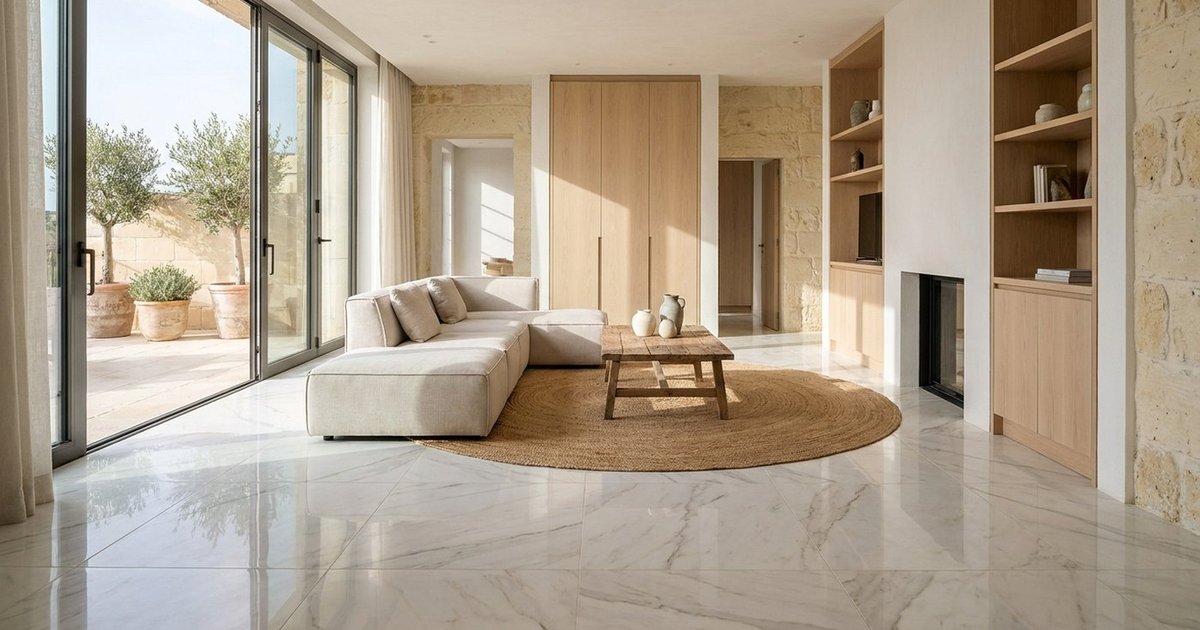
If you have just bought a shell-form property in Malta, the terrace or roof is probably the largest single tiled area you will pay for, and it is the one most likely to go wrong in a way you can see from the sitting room ceiling. Indoors a tile is a finish. Outdoors it is the top layer of a small drainage structure, and the parts that do the work are underneath it.
There are two accepted ways to build that structure. Everything else is a variation on one of them.
Option one: tiles bonded onto a waterproofed, sloping screed
This is the conventional build and the one most Maltese contractors will quote by default. Mapei sets out the typical terrace stack from the bottom up: concrete base, slope, screed, waterproofing layer, adhesive, ceramic tiles. Insulation panels, bituminous waterproofing and a reinforcing mesh in the screed may also be present depending on the job.
Read that order again, because it is the whole argument. The waterproofing sits under the tiles, not in them. Mapei states it directly: waterproofing cannot be achieved simply by making the grout joints waterproof. Success depends on how every layer under the tiles is built, not just on the adhesive.
Mapei's published sequence for a new terrace runs like this:
- Form a sloping screed (its own example product is Topcem Pronto).
- Waterproof with a two-component cementitious membrane — Mapelastic Turbo — applied in two coats with a reinforcing mesh (Mapetex Sel N) between them, to a finished thickness of at least 2 mm.
- Lay the tiles with a deformable adhesive (its example is Ultralite S1 Flex Quick) using double buttering — adhesive combed onto the substrate and onto the back of the tile.
- At perimeter and expansion joints, fit a foam backing cord (Mapefoam) before sealing with a sealant.
On adhesive, Mapei's guidance for outdoor work is a class 2 (improved) adhesive, and for medium to large tiles between 30 and 60 cm a side, an S1 deformable adhesive — its example being Keraflex Maxi S1, a C2TE S1. If your quote says "tile adhesive" with no class, that is worth a question, because most terrace tiles sold today are in that 30–60 cm bracket or larger.
If you are tiling over an existing outdoor floor rather than a new slab — common in Malta, where terraces get re-done rather than rebuilt — Mapei notes that a deformable waterproofing system such as Mapelastic reduces the stresses passing through.
Option two: 20 mm porcelain laid dry
The alternative is to leave the membrane as the finished waterproof layer and set a thick porcelain paver loose on top of it. Living Ceramics, a Spanish maker of 20 mm outdoor pavings, describes three ways its 20 mm material can be installed:
- On pedestals, as a raised floor, with pipes and cables hidden in the void underneath and no adhesive used at all.
- Dry on grass, sand or gravel, on a bed of about 6 cm of gravel with a 4 to 8 mm particle size.
- Bonded with adhesive like a normal floor tile — which the maker suggests where there is heavy foot traffic or vehicles, such as garages and ramps.
The maker's case for the material is that it is non-porous, does not absorb water and so will not crack from it, and it compares the 20 mm product with standard 9 mm tiles on durability. Its 20 mm ranges come in 90x90 cm and 120x120 cm with anti-slip finishes.
The practical appeal of the pedestal version on a Maltese roof is that nothing is stuck to the membrane. Water runs under the slabs to the outlets, slabs lift out for access to services, and a failed membrane patch can be reached without demolishing the floor. The practical costs are height — a raised floor eats door and threshold levels — and weight. A 120x120 cm slab at 20 mm is a two-person lift, and if the property is in Gozo every pallet of it crosses on the ferry, which shows up in the delivery line of the quote rather than the tile price.
The membranes a Maltese contractor will offer
Kibitec, a Maltese waterproofing contractor, lists four types, and these are the words you will hear on site:
| Type | How it is described |
|---|---|
| Cementitious | Flexible, suited to outdoor use, resists water pressure, bridges cracks, UV resistant |
| Liquid membrane | Fully bonded liquid-applied coating; presented as cost-effective for roof renovation and for filling cracks |
| Bituminous | Dense, sticky bitumen-based layers, for homes and commercial buildings |
| Polyurethane | Seamless, long-term flexibility, resistant to root penetration |
Kibitec's argument is the obvious one: a well-waterproofed roof lasts longer and needs fewer repairs. What it does not publish is any thickness, guarantee period or price for any of the four — so you cannot compare them on paper, and you will have to ask for all three in writing.
Slope is the part nobody writes down
None of the sources read for this article publishes a fall percentage for a terrace. We are not going to invent one. What you can require is this: the screed must fall towards the drainage outlets, with no flat spots and no back-falls where water stands, and the contractor should state the fall he is building in the quotation rather than leaving it to the trowel on the day.
Turnkey.mt's tiling page says its scope includes terraces laid with proper drainage falls, along with surface preparation and screeding, and that the subfloor must be level and sound and wet areas waterproofed before tiling. That is the right framing: screed and waterproofing are separate works that happen before anyone opens a box of tiles.
What to ask before you agree a price
No source publishes an outdoor-specific rate. The figures printed on Turnkey.mt's page are standard tile labour €20–€40/m² (split on the rate card as €20–€28 for ceramic and porcelain and €30–€40 for large-format), book-matched slabs labour €52–€80/m², and for materials, ceramic and porcelain €15–€30/m², natural stone and marble €40–€80+/m², book-matched slabs €75–€150/m². There is no terrace line. Treat the tiling rate as one line among several and ask for the rest separately:
- the screed, and the fall it will be laid to;
- the membrane — which of the four types, how many coats, with mesh or without;
- the adhesive class and whether it is deformable, if tiles are bonded;
- perimeter and expansion joint treatment;
- for a raised floor, the pedestals and the drainage path under the slabs.
On the tiles themselves, Maltese showrooms rarely publish which brands they hold, so matching a specification to a stockist usually means asking several. Sicily is a ferry away and often cheaper for the same Italian names; within the EU, VAT is paid once in the country of purchase, so a Sicilian invoice is not re-charged here — but the pallet still has to get to the site, and to Gozo that means a second ferry. Decide the build-up first. The tile is the last decision, not the first.
Common questions
- Do waterproof grout and good tiles make a terrace watertight?
- No. Mapei states plainly that waterproofing cannot be achieved simply by making the grout joints waterproof. The watertight layer is a membrane under the tiles, and whether the terrace works depends on how every layer beneath the surface is built, not on the tile or the grout.
- What slope should my terrace screed have?
- None of the sources we have read publishes a figure, so we are not going to invent one. What you can insist on is that the screed falls towards the drainage outlets, that there are no flat spots or back-falls where water sits, and that the contractor writes the fall he intends to build into the quotation before work starts.
- What is 20 mm porcelain and why would I use it on a roof?
- It is a thicker porcelain paver — Living Ceramics, a Spanish maker, offers it in 90x90 cm and 120x120 cm with anti-slip finishes. It can be laid dry on adjustable pedestals as a raised floor, with pipes and cables hidden underneath and no adhesive at all; laid dry on a bed of about 6 cm of gravel of 4 to 8 mm particle size; or bonded with adhesive like a normal tile, which the maker suggests for heavy foot traffic or vehicles such as garages and ramps.
- What will a terrace cost per square metre in Malta?
- No outdoor-specific rate is published by any source we have. Turnkey.mt's tiling page prints standard tile labour at €20–€40/m² (the rate card behind it splits that as €20–€28 for ceramic and porcelain and €30–€40 for large-format) and ceramic and porcelain material at €15–€30/m², and says its scope includes terraces laid with proper drainage falls — but it does not state a separate terrace figure, and that labour rate does not include screed, membrane or pedestals. Ask for those as separate lines.
What we could not establish
- No source read gives a slope or fall percentage for a terrace or roof screed — not Mapei, not the Maltese contractor pages. The number is simply not published.
- Mapei's terrace waterproofing page gives no cure or waiting times between screed, membrane coats and tiling, so the realistic length of the job is unstated.
- Kibitec lists four membrane types but publishes no thicknesses, no guarantee periods and no prices for any of them, so the four cannot be compared on cost or expected life.
- No source gives an outdoor or terrace-specific labour rate, or any rate for screeding, membrane application or pedestal systems in Malta.
- No source names a Maltese supplier of pedestal systems or 20 mm porcelain, or says whether raised floors are commonly built here at all.
- Nothing in the sources covers wind uplift on unbonded raised floors, which matters on exposed Maltese roofs.
Sources
- Terraces and balconies — Mapei (Italy) · read 2026-10-05
- System for waterproofing new terraces with two-component cementitious products followed by the installation of tiles — Mapei (Italy) · read 2026-10-05
- 20mm outdoor pavings — Living Ceramics (Spain) · read 2026-10-05
- Waterproof membrane — Kibitec Ltd (Malta) · read 2026-10-05
- Tiling & Stone — Turnkey.mt — Turnkey.mt (a CheckYourTraders company) · read 2026-10-05
- Turnkey.mt rate card (js/rates.js), tiling surfaces — Turnkey.mt · read 2026-10-05
Drafted with Claude — claude-opus-5, then read, corrected and approved by Neil Bennett before publication. We do not publish anything a person has not read.
Ready to price it?
One upload goes to every showroom that stocks what you are after, in Malta and Sicily.
Get quotes