Costs & budgets
How much do tiles cost in Malta?
The tile and the tiler are two separate costs, quoted in different ways by different people. This is how each side of the bill is built up in Malta, and which parts nobody publishes.
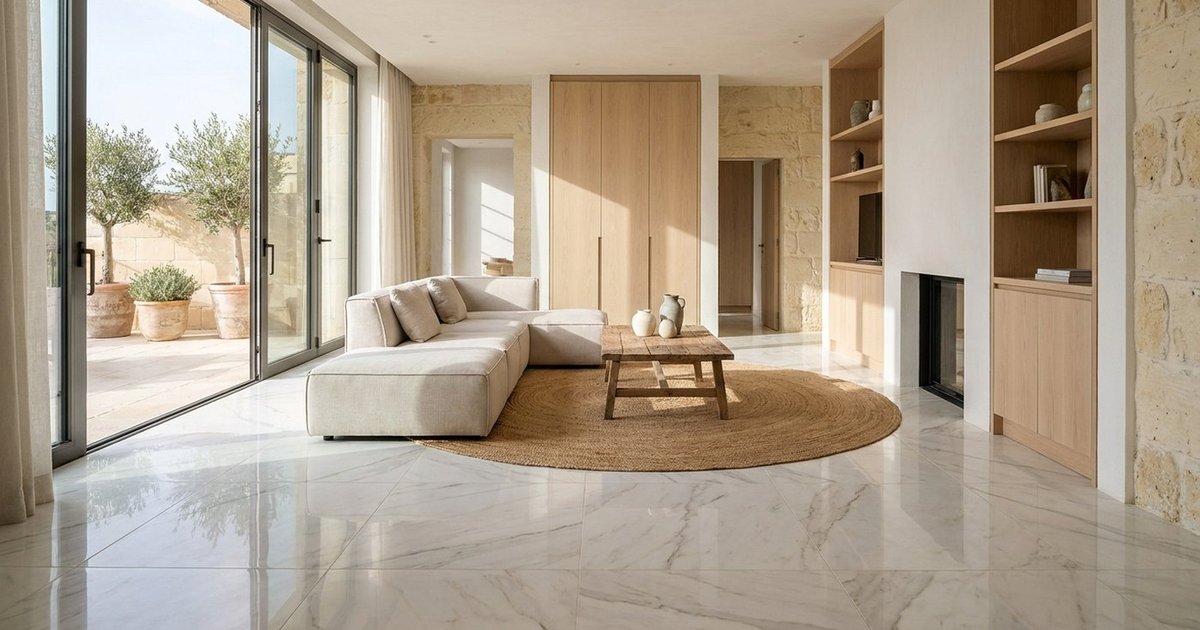
There are two numbers in a tiling job and they come from two different businesses. The tile is bought from a showroom, by the box, and priced per square metre of tile. The laying is bought from a contractor, by the job, and priced per square metre of tiled surface — which is a different and usually much larger number. People who have just bought a shell apartment routinely budget for the first and get surprised by the second.
This article separates them.
The tile: what you are actually buying
Tiles are sold by the box. The showroom converts your area into a box count, and the box count is what you pay for, so the price per m² on the display card is a rate, not a total. Two things inflate the total above your measured area: cuts, and the spares you should keep from the same production batch. Tiles are made in batches and shading varies between them, so a box bought a year later to patch a cracked floor may not match. Order the spares with the original order or accept that a repair will be visible.
Published prices are rare in Malta. Most showrooms display tiles in the shop and will quote on request, and most do not publish which brands they carry — which is the core problem when you have seen a tile you like and want it priced. A few Malta retailers are the exception and list porcelain prices per square metre online, by product. Treat any such list as one retailer's spread, not the market average. If you have a tile in mind, ask us and we will get it priced.
The broad ordering of material cost is predictable even where the numbers are not published:
- Ceramic — the cheapest, wall-weight, not for heavy floor traffic or outdoors.
- Porcelain — denser, harder, the default for floors and increasingly for everything.
- Large-format porcelain — same material, more money per m², and considerably more money to lay.
- Natural stone — variable by type and by block; also needs sealing and maintenance the others do not.
- Slabs — the top of the range, both to buy and to handle.
Sicily, VAT and the ferry
Sicily is a ferry ride from Valletta and often cheaper for the same Italian brands, because you are buying closer to where they are made and in a much larger market. Within the EU, VAT is paid once, in the country of purchase — buying in Italy does not generate a second Maltese VAT charge when the pallet lands.
What it does generate is logistics. You are arranging haulage, you are accepting the breakage risk in transit, and if the shade is wrong or a box is short you are a ferry away from the fix. For a large single-tile job with a long lead time this can work out well. For a fiddly job with three different tiles and a deadline, the saving is often eaten by the second trip.
If the property is in Gozo, add a ferry to every delivery — the original order, the extra box, the replacement for the cracked one. That is a scheduling cost as much as a money one.
The laying: why bathrooms are priced by surface
Floor tiling is measured as floor area. Bathrooms are not, because bathrooms are mostly wall.
A 2m x 2m shower room has 4m² of floor. Tile all four walls to a 2.4m ceiling and you add roughly 19m² of wall before deducting for the door and any untiled panel. The tiled surface is five times the floor area, and every one of those square metres takes labour, adhesive and tile. This is why a small bathroom can cost more to tile than a large bedroom floor, and why "it's only a tiny bathroom" is a misleading way to think about the budget.
The same logic applies to niches, window reveals, bath panels and anything boxed in around pipework — all of it is tiled surface, all of it takes cutting, and small fiddly areas take disproportionately more time per square metre than open floor.
Turnkey.mt publishes its tiling rates on its tiling and stone page. That page is the live figure and is where you should read it; rates move, and a number copied into an article ages badly. What matters here is understanding what the rate is multiplied by — the surface area, not the room.
Three things sit outside the basic per-m² rate and belong in every conversation with a contractor:
Large format. Big tiles need flatter substrates, more than one person to place, levelling systems, and a wet saw that can take the sheet. The material costs more and the labour costs more; a large-format floor is not the same job as a 30x60 floor with a bigger tile.
Strip-out. If there is an existing floor, someone has to break it up, bag it and remove it, and then make good whatever is underneath. In an older Maltese property that may reveal an uneven bed that needs re-screeding before anything can be laid. This is why renovation quotes and shell quotes are not comparable: a shell has nothing to remove.
Tanking and waterproofing. In any wet area the waterproofing layer goes on before the tile, not instead of it. Kibitec's guide to waterproofing screed in Malta sets out how that layer is handled here. Grout is not waterproof and tile alone is not a waterproof system; what stops water reaching the structure is what is underneath. Expect it as a separate line on the quote, and if it is absent from a bathroom, terrace or roof quote, ask why before you ask about price.
Working out your own number
- Measure every surface that will be tiled, wall by wall, and total it. Deduct doors and windows. Keep the list — you will be handing it to several people.
- Take that area to showrooms and ask for a box count and a total for the tiles you actually want, including spares.
- Take the same area to contractors and ask for laying, stated per m² of surface, with strip-out and waterproofing itemised separately.
- Add delivery, and a Gozo ferry if that applies.
The two halves rarely come from the same conversation, and the commonest budgeting error is comparing one supplier's tile-only figure with another's tile-and-labour figure. Make everyone state which they are quoting.
Common questions
- Why is my bathroom quoted in more square metres than the floor area?
- Because tiling is measured across every surface that gets tiled, not the footprint of the room. A 2m x 2m shower room has 4m² of floor but can easily carry 20m² or more of wall once you tile to ceiling on four sides. Ask any quote to state the surface area it was calculated from, and check that number against your own tape measure before you compare it with anything else.
- Is it cheaper to buy tiles in Sicily?
- Often, for the same Italian brands, because you are closer to the factory and buying inside a larger market. It is a ferry ride from Valletta. VAT is paid once, in the country of purchase, so buying in Italy does not create a second Maltese VAT bill on arrival. Against that, set the ferry, the haulage, the fact that a breakage or a shade mismatch means a second trip, and the difficulty of getting a replacement box from the same batch months later.
- Do I pay for waterproofing separately from the tiling?
- Usually yes. Waterproofing sits under the tile as its own layer of work, applied to the screed before anything is laid, and it is normally a separate line rather than something bundled into the per-m² tiling rate. Treat any quote that does not mention it for a shower, a bathroom floor, a terrace or a roof as incomplete and ask what is going under the tile.
- How much material should I order over the measured area?
- More than the bare measurement, because of cuts, breakages and the need to keep spares from the same production batch for future repairs. How much more depends on the tile size, the layout and how much diagonal or pattern work is involved. Ask the showroom to calculate the box count for your actual areas rather than ordering to the round number yourself — tiles are sold by the box, not the loose square metre.
What we could not establish
- No Maltese showroom directory publishes a market-wide price index for tiles, so there is no authoritative 'average price per m²' for ceramic, porcelain, natural stone or slabs in Malta. Figures quoted elsewhere are usually one retailer's range presented as a market norm.
- Most Maltese showrooms do not publish a brand list at all, let alone per-brand pricing, so the only reliable way to compare the same tile across showrooms is to ask each of them by name.
- Neither of the retail sources sets out delivery charges, Gozo ferry surcharges, or whether delivery is to kerbside or into the property.
- None of the sources establishes a separate rate for natural stone or large-format slab laying as distinct from standard tiling, nor what size threshold triggers a large-format surcharge.
- None of the sources gives a typical wastage allowance percentage for cuts and breakages.
- Sicilian retail pricing is not covered by any of the sources here, so the comparison with Malta is a structural one, not a numeric one.
Sources
- Tiling & Stone — Turnkey.mt — Turnkey.mt (a CheckYourTraders company) · read 2026-09-21
- How To Waterproof Screed In Malta — Kibitec — Kibitec Ltd (Malta) · read 2026-09-21
Drafted with Claude — claude-opus-5, then read, corrected and approved by Neil Bennett before publication. We do not publish anything a person has not read.
Ready to price it?
One upload goes to every showroom that stocks what you are after, in Malta and Sicily.
Get quotes